Why Terminal Z Didn't Work and Bouquet Bound Did
"The problem with trying to tell unhinged stories is that you have to juggle a lot to get there, you have to be able to keep people up to date with the premise, [and] you have to enforce it throughout."
-Viveros (YouTuber) -
"Spike Chunsoft and Telling Unhinged Stories"
You probably haven’t heard of Terminal Z. I mean, I wouldn’t blame you. It was a small YA sci-fi webcomic posted on tumblr dot com that only got a few notes worth of attention. It was about a space-time protection agency that fought to correct distortions in the fabric of space and time, featuring our (by which I mean my) favorite edgelord girl Isabel Union. She's still tattooed on my left arm, bee tee dubs. The only way you’d really know Terminal Z is if you were friends with the creator when they made it, back in 2015-2017 or so.
The creator was me, by the way. Hi there, hello.
Yes, me. The person who nowadays mainly writes bad end lesbian erotica featuring mean business ladies doing mean things to cute scared girlthings. That was how I got my start, in sci-fi YA webcomics.
And I say this with all respect and love towards my past artistic endeavors, which were the foundations of my art today — it fucking sucked. I promise I say this with love — we all kinda hate on our old work while acknowledging we all start somewhere. It had no middle, and a weak beginning/ending to boot. It was written with an unstable outline, one-dimensional characters, and throwing whatever at the walls and hoping it stuck. A lot of the ideas were taken from much better stories and shabbily glued together. Not to mention, the art wasn’t anything to write home about, unless you were complaining about it!
Despite being written in 2015 or so, Terminal Z had been in my mind for years. Probably 5 or so? I definitely started it in at latest 2010. It was just marinating there as I reworked the concept over and over, put more things in, and tried to make a middle part of the story. Key word, tried. Terminal Z didn’t have a middle because I couldn’t fit one in. Not for lack of space (no pun intended), but for lack of a solid structure.
And the way it marinated in my head for that long, ultimately, is why it failed. Failed to have the fanbase I dreamed of (remember that); failed to be a structured story; led to one of the most painful comic rejections I've ever had in my life that has stuck with me to this day; failed to be something I continued regularly before burning out repeatedly; and failed to be sustainable as a webcomic.
While in the relatively niche genre of hypnosis erotica, there is a significantly higher chance you have heard of Bouquet Bound (formerly known as ‘Split Slave’).
Bouquet Bound is about a rich business trans lady buying a non-binary submissive with dissociative identity disorder at auction, who finds the experience much more freeing than expected. It's a story about finding safety in dangerous places. It features a lot of... y'know, things you wouldn't expect in mind control erotica. A Pokken Tournament DX arc. A plural character reconciling with their protector and having trauma come to the surface (via Pokken Tournament btw). More non-binary characters than not who don't exist for fetish reasons. A cis guy blackmailing the non-binary protagonist while misgendering them — and him not being indulged. And it only gets more insane when I wrote the sequel, Garden Ablaze, but that's a whole separate story.
It’s easy to point at Bouquet Bound and say, “well, of course it’s more popular. It’s erotica. By default, erotica is more popular than SFW content.” And to some extent, you may be right. But erotica automatically being popular and successful is a enormous misconception. Same with all kinds of erotic content creation. It’s highly dependent on luck, on narrowing in on gaps in a community of works, and on how your work differs from the thousands of other stories. And, entirely by accident, I struck gold.
Crucially, this was a story written for emotional catharsis. A wise screenwriting teacher told me to write from my scars, not my wounds, and holy hell did I not follow that (excellent) advice. In fact, before submitting it to Simon MCStories, I said out loud to myself, "No one is going to read this." And I didn't plan for anyone to.
It just so happens I severely underestimated how many trans and/or plural people were reading hypnosis kink erotica.
Now, Bouquet Bound — in its first draft at least — was, similar to Terminal Z, shabbily written, unedited, and had anything and everything thrown at the wall to see what stuck. And I mean unedited in the most literal way. I would word vomit the chapter and send it to the owner of MCStories, and pray there weren’t any typos. This, as you can imagine, was not the best method.
If you don't believe me, I'll tell you this: One line in one of my stories read verbatim "the next guy who walked through the door was a guy who walked through the door."
Yeah. He sure walked through that door.
Today, I want to talk about why the unhinged storytelling didn't work in Terminal Z, but worked perfectly for Bouquet Bound. What were the differences? Why did unhinged storytelling work in one but fall apart in the other?
I'm not the arbiter of truth nor really an expert, but I'd love to share my hypotheses with you.
What was Terminal Z and why didn’t it work?
As mentioned, Terminal Z was a sci-fi webcomic aimed at young adults, probably like 15 year olds to 19 year olds. Which were, uh, the exact ages I worked on it. Theoretically, it was about a space-time protection agency that'd fix or fight distortions in the fabric of space-time and eliminate people who caused them. Cool idea, terrible execution.
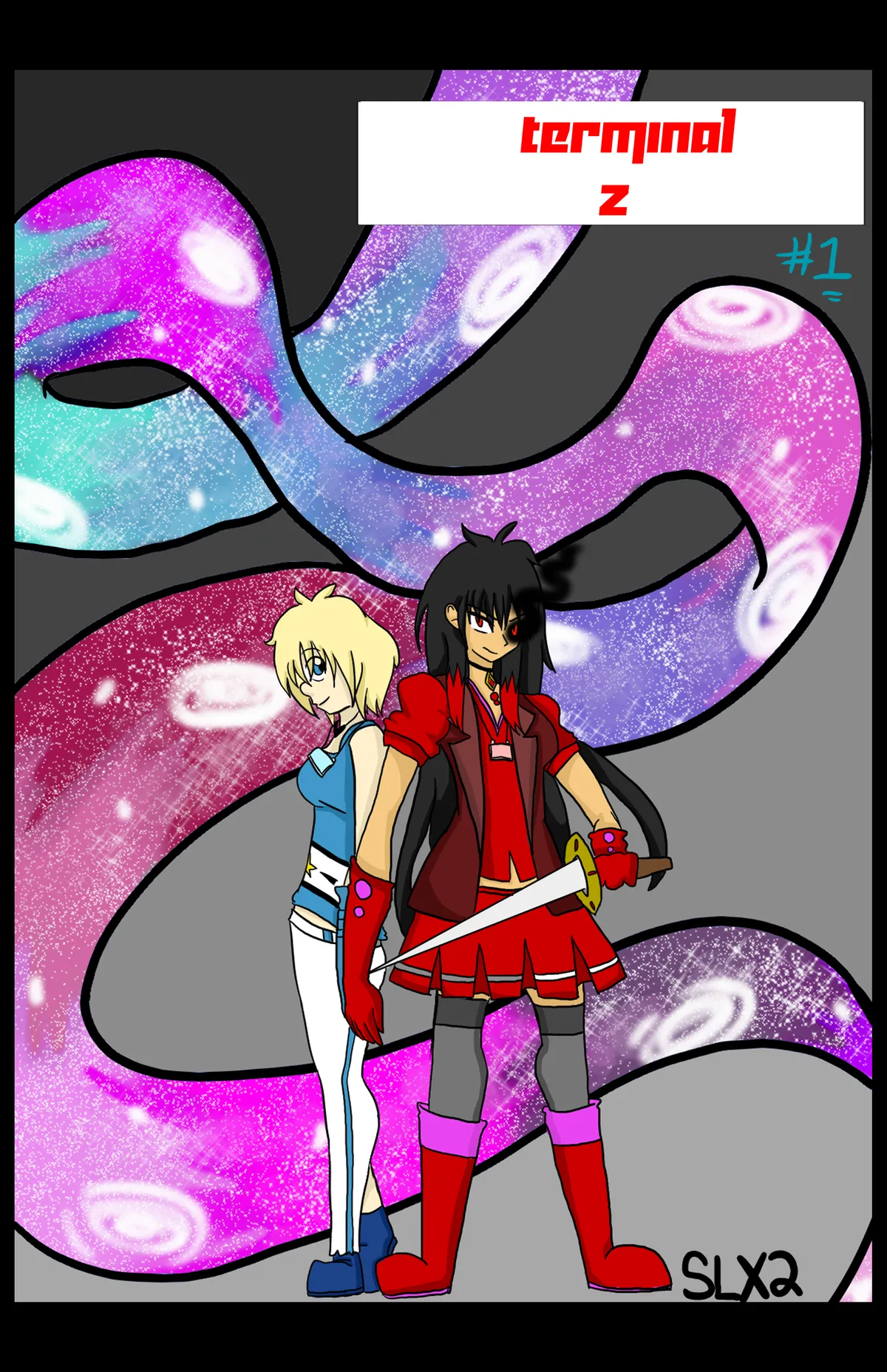
In the intro, I went into some of my guesses why TZ didn't work; let me outline them in more detail:
- Shaky Middle Section: If you asked me to give you an elevator pitch for Terminal Z, I could not, for the love of my life, give you a good one. Terminal Z had a beginning and an end, and the way I wanted to get from point A to point B was... I actually don't know? I was thinking of using Persona 3's method, but that wouldn't make sense, because Persona 3 used the lunar cycle and Terminal Z took place between dimensions. So uh, I was kinda left at a loss, because I wasn't used to stretching my creative muscles intentionally.
- One-Dimensional Characters: It didn't matter how many character dossiers I filled out: the characters were, at the core, one-note and shallow. Their backstories didn't influence their personalities and world systems the way I thought they did, and many of them didn't really need to be there, so I was even MORE stretched thin balancing multiple character arcs with a mediocre plot.
- Weak Art: Yes, yes, the more you draw, the more you improve, but the issues went deeper than that. My insecurities were still there, and even thinking about trying to improve intentionally was daunting. Did that improve my art? No, of course it didn't. Webcomics don't need to be high art, but I wanted to do an impressive anime-themed sci-fi story, and the mediocre art hurt what I was trying to do.
- Trying Too Hard: Perhaps my greatest sin in all of writing. I wanted to be famous. I wanted to get publishing contracts, to see my webcomic adapted into an anime, yadda yadda yadda... you know how this mindset ends. Craving recognition is an insatiable form of gluttony. You'll never be satisfied no matter how much attention you get. Not to mention, becoming rather well-known in a small community for BB was beyond overwhelming for me, so much so that it heavily contributed to my burnout. It was great, don't get me wrong, but for my socially anxious demeanor? Not the best fit.
- The Audacity (negative): Terminal Z was not good, and I wanted so badly to prove to people otherwise. People are not going to flock to your story with transparent attempts to bait people into engaging with it. But oh lord did I try so hard and looking back? It was probably me at my most obnoxious.
But perhaps my biggest guess: Terminal Z didn't work because the premise is fundamentally flawed. Not only that, but TZ failed for one massive reason. Apologies for getting personal on a writing related post, but I struggled with BPD for a large potion of my young adult life, the worst of it being in undergrad.
I'm thankfully considered in remission from it now, and I consider it a blessing I am. If you know anything about BPD, one of the hallmarks is a struggle to accept critique. Over the years, I got better about doing so... that is, on a technical level. Things like character design, art, proportions? That was fine. Anything further and I took it as a personal attack.
Unfortunately, deeper critique was exactly what I needed.
What was Bouquet Bound and why did it work?
Bouquet Bound is a story about a non-binary plural system selling themself at auction and being bought by a mean businesslady who wants to train them into her perfect plaything. As Lily gets trained, their headmates come to the surface, as does their trauma, and they find healing in their Mistress, a mismatched group of friends they make, new hobbies, and reconciling with combative headmates. Of course, there's a lot, and I mean a lot, of D/s, sex, hypnosis, training, and as many kinks as I wanted to stuff in it (no innuendo intended).
It's about finding safety in dangerous places.
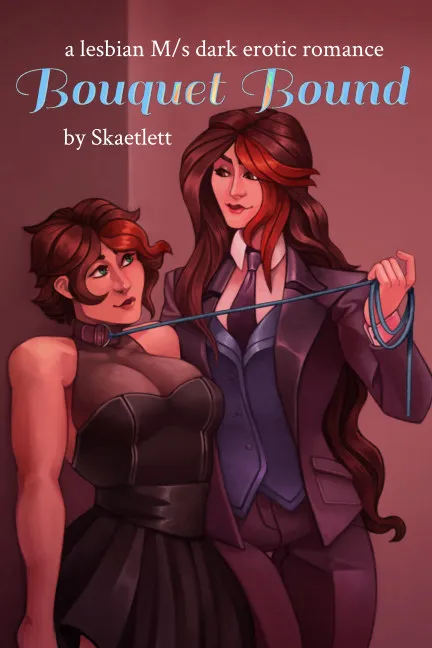
Lily, the main character, is the most obvious self-insert since My Immortal (2005) (actually, never mind, I could never hope to have a fraction of the power of the author of My Immortal.)
Above, I talked a little bit about my struggles with accepting criticism. And I took criticism for BB better than TZ for one big reason: to an extent, I didn't care too much.
With Bouquet Bound, it didn't necessarily matter if the structure was flawed, for a very simple reason: I wrote it with the goal of catharsis. I just wanted to process my emotions from a difficult time of my life. If people liked it, great; if they didn't, whatever. I still accomplished my goal. My expectations were on the floor.
Except, many people loved it.
Of course, it wasn't for everyone. Not everyone wants to read dubious consent erotica about someone being bought at auction. Crucially, this is important to keep in mind, especially considering the unsavory history of human auctions.
I have some guesses as to why it worked as an incoherent story. Here they are:
- Representation: This is perhaps my most reasonable guess. In erotica, disabled people and transgender people are both heavily misrepresented. They're either not in it at all; in it as an unrealistic fetish; or depicted in some otherwise offensive way. Despite this, there is a large audience of that exact demographic: disabled trans people. (which I didn't know! wow!)
- Novelty: It was new. Bouquet Bound might have tropes and elements from other common stories (someone described it as similar to Sold to One Direction Fanfics, and I
hatelove how accidentally true that is). Mean businesslady dommes and human auctions are common fantasies. But they were mixed in a new way, and most importantly, they were mixed. Not as separate elements, but palettes of paint that worked together to make new colors. - Characters: I love Lily and Magnolia. Sure, I loved Valarie and Isabel from Terminal Z too, but not in the same way. These two characters were emotionally charged for me. They were, and are, near and dear to my heart. And it showed! That passion showed, especially because it was not tainted by jealousy or insecurity. These characters were unabashedly themselves, openly pieces of me and my history. And the side characters were also fun, many sticking with people. This was even improved when an editor came in and improved a lot for me. Pierre's husband being Machamp is kind of amazing.
- Unporniness: Bouquet Bound was written for people who wanted plot first, and porn second. It wasn't filled with sex all over the place, and opportunities for characters to have intimacy weren't given if it would hurt the plot. When Rye blackmailed Lily into having sex with him, it would have been (ugh) a good opportunity to have that happen for the audience to get their rocks off (particularly straight guys who didn't like that Lily was non-binary). But it would have hurt the narrative, and crucially, it would have made me vomit.
- The Audacity (positive): Oh god did I have the audacity. I truly just did whatever I wanted. And it worked for the most part. I added in what I wanted, what I thought the story could use, and not what the audience thought. Hell, due to MCStories' wonky UI, I didn't even know how many people were reading aside from the few who emailed me.
Again, all of these are what I said: guesses. Truthfully, it could be something else. It could have just been luck. I'm no expert in storytelling, but I'm arguably an expert in my own stories.
Bouquet Bound was actually only supposed to be 14 chapters, ending with Magnolia rescuing Lily from Crimson. But then I was like, I don't want the story to end! So I drafted a second half of the story and went at it. Was it the strongest idea from a plot planning perspective? Not really. But it led to more moments of rising tension, of love to be built between them, of a fiery climax that showed the characters at their most broken. Terminal Z had none of those moments, and crucially, not nearly as strong of a middle thread.
How Ideas Marinating Hurts Their Coherence?
Have you ever had a weird, vivid, and/or interesting dream? Perhaps one that inspired a story? Well, I'm sure if you ever have, your first instinct would be to try to explain it to a friend. You might have even thought, "this would be a great story!" and then wrote it down.
Unfortunately, dreams are famously nonsensical and difficult to follow. You are the one who is most familiar with your brain. Similarly, you are the one most familiar with your idea. Just like explaining vivid dreams in a coherent way is tenuous, so is explaining intense, deep worldbuilding lore. (Especially if you don't have the worldbuilding fully fleshed out.)
This is especially crucial with stories that require plenty of worldbuilding (sci-fi and fantasy being the hardest), and to do so while showing that storytelling and not turning to the camera and explaining word by word to the reader. I'm certain you've gathered this, but Bouquet Bound takes place in a realistic world. Kind of. Sexualized auctions aside. Bouquet Bound didn't require pages upon pages of lore and worldbuilding, like Terminal Z did. That gave me the chance to really focus on the characters, the relationships, the highs and the lows. It's like juggling three ping-pong balls versus juggling eighteen chainsaws that are all on fire.
I could have put down the chainsaw juggling, but then I'd be hurting my pride. It would feel like throwing away all my hard work. My inability to kill my darlings hurt my writing significantly, because I felt it was like losing a part of myself. It wasn't. But it felt like it.
I wasn't a good enough writer to do that. Am I a good enough writer now?
Maybe.
So I tried again.
Why Distortionized STILL Didn't Work
This sounds random, but bear with me: the Tower is one of the tarot cards I'm most drawn to. It signifies sudden change, and oftentimes, the foundations of which you've built your life crumpling. A common interpretation of the Tower is having built your life, or a certain endeavor, on a shaky foundation that then falls apart.
I bring this up because I was an entirely self-taught writer. I took some writing classes in college that made me shape up, yes, but by that point I was either burnt out on the webcomic or overwhelmed with the concept of rewriting everything. But when I learned writing skills alone, in a vacuum, I didn't necessarily build the strongest foundation. Especially without feedback, someone to correct plot holes, to polish it.
Hell, when I had editors for Terminal Z through my college's comics club - THREE editors, to be precise - they couldn't fix it.
And then you keep building that shaky foundation, and you keep doing that, until everything comes crashing. In those moments, turning back to the basics — "how to write good" — is a decent course of action to rebuild it. But you can't deny the sting. You can't deny how much rejection hurts; how much it hurts to see work you've staked your life on falling apart.
Right now, let's focus on the concept of shaky foundations, and how it relates to worldbuilding and storytelling.
In my last blog post, I talked about narrative incoherence in the 2nd Mario Movie. The more elements of a story you have to juggle, the harder it becomes. Most stories have an A plot and maybe a B plot. Maybe some running gags here and there. But anymore than that gets hard to keep up with, to say the least. Once again, I struggled to do too much, and while things like character dimension, writing quality, and new cast of main characters definitely improved, I never improved the worldbuilding.
So it fell apart.
Oh well!
How Do You Make An Incoherent Story Consistent?
Gonna be real here: I don't know.
The hardest part of fixing incoherent stories is that the reason they're incoherent is often the very core of the issue. And when stories are personal to you, it feels like a deconstruction of you, of your past, of the core of who you are. The only way you can get past this insecurity is to work on it from the inside.
And unfortunately, sometimes it's just easier to throw out a story (maybe salvaging what you can) than to endlessly rework it.
If you want to rework a story, there are a few steps you can take. Here are some of my suggestions, many a bit more abstract:
- Touch grass: This sounds like the most basic ass bitch thing I'm going to say, but there truly is a lot you can get from just being outside. Clean air is refreshing, walking around finding new things can jolt your inspiration, you can view people interactions by listening to people talk, and there's beauty at every corner if you know how to look. Even if you don't take literal inspiration from nature, your brain does the smiley emote when you engage with nature. (I think. Might or might not be scientifically proven.) Similarly, try new hobbies. You never know whether you will or won't find something that can help you break out of a funk, or find the answer you've been looking for.
- Engage with a lot of similar media: Now, don't do what I did and write things word-for-word (or point-by-point) into your story. Not only is it wrong and creatively dubious, but it doesn't work. You can't stitch silk to a square piece of seaweed. Transform the ideas that inspire you. Create a new mix as opposed to just two boxes of paint next to each other. Think how one thing interacts with another that can interact with another. And perhaps most vitally, see fellow creators as your friends and inspiration, not your competition.
- Look at it from another direction: To
plagiarizetake inspiration from Ace Attorney: Turn your thinking around. Ask a question you didn't ask before. A good question is "what am I not seeing?", but asking more specific questions helps more. For Terminal Z, instead of "what should happen in the middle?" I would probably ask something like, "how can the middle parts gradually build towards the climax?" Just an example, but many times, story issues can be solved by asking yourself the right question. - Wish fulfillment: Yes it's cliche, but unless you are writing for money, genuinely just write what you want. Not what you think other people want. Not what you think will sell. What you, reader, will want. When people see your passion, it's contagious, it's an incredible force. But passion has to be used positively. If you're passionate to the point of being angry people won't engage, readers will see that too.
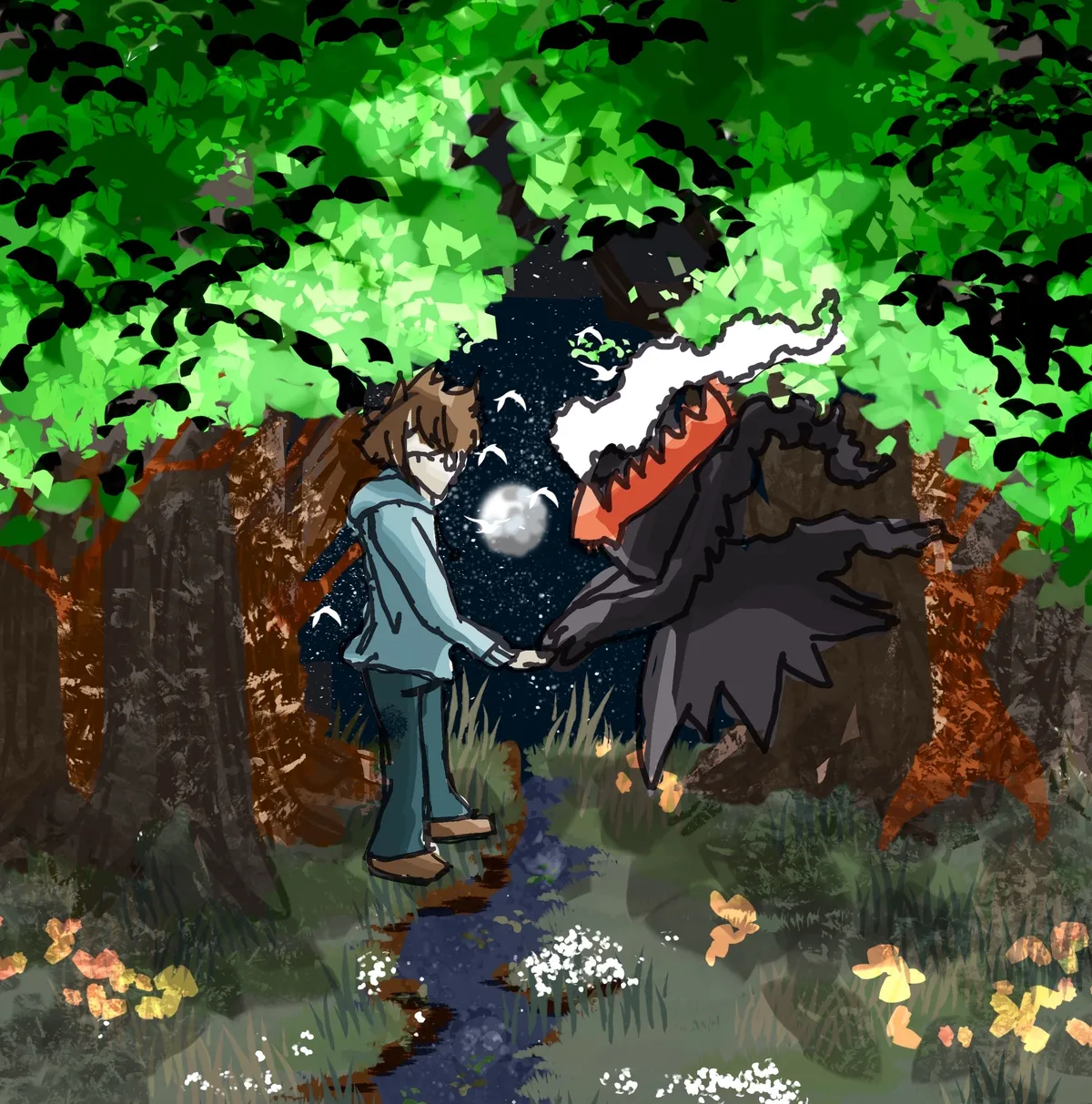 (speaking of indulgence: here's me and Darkrai being romantic. don't @ me)
Final Thoughts
Unhinged stories need editors because the ideas you’ve had in your brain for years won’t make sense to people unless you explain it. Terminal Z was a messy story. Unfortunately, no amount of good editing could have saved Terminal Z without going to the structural level. When I rebuilt TZ over and over again, I changed the characters, style, that kinda thing, but I never changed the fundamental structure.
I had to beg people to read Terminal Z, and usually they didn't. But good representation, new stories, and a heavy dose of The Audacity can bring a mediocre incoherent story to a blaze of unhinged-ness beyond anything we can ever dream of.
Again, this is my hypothesis, but I think life experiences also made me more capable of writing unhinged stories. In 2021, I had an epiphany out of nowhere: that nothing external was going to fix my internal faults. Yes, this sounds obvious, but in the midst of BPD... it really wasn't. So I started experiencing life with a beginner's mindset. I tried new hobbies, went to classes, tried things, went through life with an open mind and appreciated everyone and everything.
This was only compounded in 2022 when I found out I inherited my father's genetic cancer disorder(1), which led to me becoming involved in cancer research and advocacy (hi, MPH student now). And further so in 2024 when my dad died. Life experiences and hardships give you inspiration. That's not to say they're good things and [insert stock inspirational quote about how everything happens for a reason]. They sucked ass, and I wish I didn't go through them. But they built me up, made me more able to accept criticism, and gave me deeper insight. In a roundabout way, this made me able to write incoherent stories coherently.
(1)(hell, I started writing this into Bouquet Bound's sequel. I think I can confidently say I'm the first person to put Lynch syndrome into mind control erotica. Thinking this'll be my next blog post?)
I'm sure that the more I write, and the more I write/read about writing, the more able I will be to make my incoherent stories coherent. Like I said, it wasn't that Bouquet Bound wasn't incoherent. It was. But it knew what it was, I knew what it was, and I wasn't trying to tell a hinged story. The fact my expectations were on the ground kind of made me better able to accept criticism, to see the structural issues, and ultimately decide if I wanted to spend potential years deconstructing the messy foundation... or just shrugging and saying "eh, it did what it could for me."
Stories don't need to be coherent to be good. They just have to be held up by everything else. Lovable characters, caring representation, or just the joy of incoherence - these things prop up a story when confusing plots don't.
Note: the Bouquet Bound cover and thumbnail for this post was done by the one, the only, Defiant Drills! Amazing artist, please follow them!
I'd love to hear your thoughts, feel free to send 'em to me: